
If you have been dealing with back pain that travels down your leg, or neck pain that shoots into your arm and will not let up, there is a good chance you have already typed "herniated disc symptoms" into a search bar. This post is a plain-language answer to what those symptoms actually describe, how to recognize the patterns that suggest nerve involvement, and what a first visit at Bonfire looks like for someone dealing with this kind of pain.
What is a herniated disc?
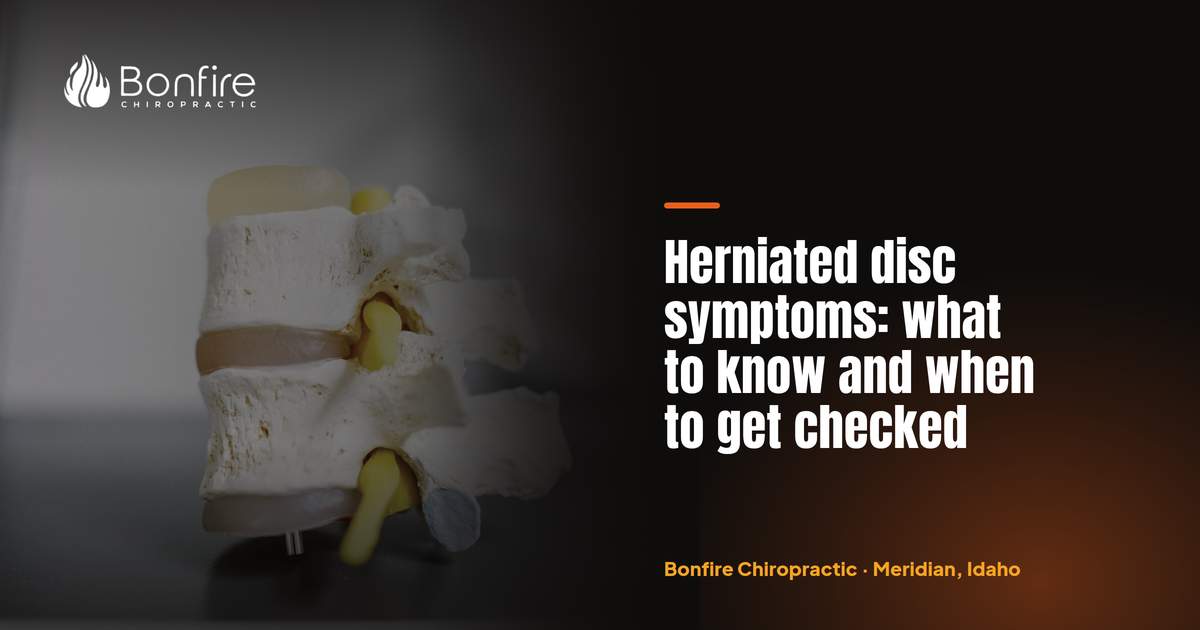
Your spine is made up of vertebrae stacked on top of one another, separated by intervertebral discs. Each disc has a tough outer ring called the annulus fibrosus and a gel-like center called the nucleus pulposus.
A herniated disc happens when that outer ring develops a crack or tear and the inner material pushes outward. If that material contacts a nearby nerve root, it creates pressure — and that pressure is typically where the more noticeable symptoms come from.
Herniated discs are most common in the lower back (lumbar spine) and the neck (cervical spine), though they can occur anywhere along the spine.
Herniated disc symptoms that show up most often
Symptoms depend on where the herniation is and which nerve it is affecting. Here are the patterns we see most often.
Pain in the lower back or neck.
A persistent, aching discomfort — often worse after sitting for long periods, bending forward, or lifting — is frequently the first sign. Some people describe a sharp, catching quality, especially when they twist or move in a specific direction.
Pain that travels down the arm or leg.
This is one of the most telling signs of nerve involvement. When a herniated disc in the lower back puts pressure on the sciatic nerve, pain can travel from the lower back through the buttock, into the thigh, and down the leg — sometimes all the way to the foot. This pattern is what most people call sciatica, and it is distinct from ordinary muscle soreness in both its path and its quality. A cervical herniation can produce a similar radiating pattern into the shoulder, arm, or hand.
Numbness or tingling.
A pins-and-needles sensation, numbness, or tingling in the arm, hand, leg, or foot can indicate that a nerve is being compressed at the level of the disc. It may come and go depending on the position you are in, or it may be more constant.
Muscle weakness.
Nerves do more than carry sensation — they also control the muscles they supply. When a nerve is compressed significantly enough, it can produce weakness in the grip, difficulty lifting the foot fully off the ground, or a sense of instability in the leg. These are signs worth getting evaluated sooner rather than later.
Symptoms that change with position.
Many people notice that certain positions bring some relief while others make things worse. Sitting tends to increase pressure on lumbar discs. Lying on your side with the knees supported may ease it. These patterns are useful clinical clues and are worth noting before your exam.
When symptoms suggest a nerve is involved
Back pain and neck pain are common, and many episodes resolve with rest and conservative care. But the patterns that suggest nerve involvement — radiating pain, persistent numbness, tingling, or any muscle weakness — deserve a prompt evaluation rather than a wait-and-see approach.
Signs to get checked on promptly:
- Pain radiating into your arm or leg that is not improving
- Persistent or worsening numbness or tingling
- Any noticeable muscle weakness
- Symptoms that are significantly disrupting your sleep or daily activity
Seek urgent care if you experience loss of bladder or bowel control alongside lower back pain. This combination is rare but serious and requires immediate attention.
One important note: herniated disc symptoms overlap with several other spinal conditions. A muscle strain, facet joint irritation, sacroiliac dysfunction, and piriformis problems can all produce similar patterns. A thorough exam gives you a clearer picture than trying to self-diagnose from symptoms alone.
What a first visit at Bonfire looks like
At Bonfire Chiropractic in Meridian, we start by looking at how your spine is moving and how your nervous system is functioning — not just where it hurts.
Every first visit includes a nerve scan that gives us an objective read on nervous system stress along the spine. We also take in-house X-rays to see the structural picture, and a thorough hands-on exam to understand the full context of what you are experiencing.
Depending on what we find, chiropractic care may help reduce pressure on irritated nerve roots, improve spinal movement, and support the body's natural recovery process. Many patients dealing with disc-related back pain or sciatica find that conservative care is a reasonable first step before considering more invasive options. We will give you a straight read on what we find and what your options are, so you can make an informed decision.
Book a $49 first visit
If you are dealing with back pain, radiating leg or arm pain, or any of the symptoms above and you are in Meridian, Eagle, Boise, Star, Middleton, or anywhere else in the Treasure Valley, our $49 first visit includes a full consultation, health history, nerve scan, exam, and X-rays.
Book online at bonfiremeridian.com/book or call (208) 266-7000. We are at 6291 N Fox Run Way, Suite 110 in Meridian. If a herniated disc is what is driving your symptoms, we want you to have a clear picture of what is happening and what your next step looks like.
You may also find it helpful to read how we think about pain and inflammation management and when to use heat versus ice for pain relief.
This is general information, not medical advice. Individual results vary. Book an exam for a diagnosis specific to you, and never stop a prescribed medication without speaking to the doctor who prescribed it.