
Why we look at the whole nervous system, not just where it hurts
Your brain, spine and nerves run everything else. When that system is under constant demand, the body shows it in ways that do not always look like a spine problem.
Your nervous system is involved in virtually everything your body does
It helps you move, think, breathe, balance, digest food, respond to stress, regulate your internal environment, and adapt to the world around you. Every moment of every day, your brain and body are communicating through an incredibly complex network of nerves.
Yet most people rarely think about their nervous system until something doesn't feel right.
Does any of this sound familiar?
- Maybe you're having headaches.
- Maybe you're struggling to sleep.
- Maybe your neck or back is constantly tense.
- Maybe you're exhausted but can't seem to slow down.
- Maybe stress seems to affect your digestion.
- Maybe you feel “wired but tired,” have difficulty concentrating, or simply don't feel like your body is functioning the way it used to.
These concerns can have many different causes. But one thing they all have in common is that the nervous system is involved in how your body experiences, processes, and responds to them.
At Bonfire Chiropractic in Meridian, Idaho, our focus is neurologically based chiropractic care. Rather than looking exclusively at where a person hurts, we look at the relationship between the brain, spine, and nervous system and how that system is functioning and adapting. This is what we mean by nervous system regulation.
Our goal isn't to claim that every health problem is caused by the spine or that chiropractic care is the solution for every condition. It isn't. Instead, we believe the nervous system deserves to be part of the conversation when we're trying to understand how the body functions, adapts, and responds to stress.
What is nervous system regulation?
Nervous system regulation is the body's ability to respond appropriately to the demands placed upon it and then shift back toward recovery when those demands decrease.
Think about what happens when you're startled. Your heart rate can increase. Your muscles become more prepared for action. Your attention becomes focused. Your body temporarily prioritizes responding to the perceived threat. That's an appropriate nervous system response.
Once the threat is gone, your body should be able to transition back toward a state that supports recovery, digestion, restoration, and normal daily function.
Your nervous system is constantly making these adjustments. It responds to physical activity, emotional experiences, changes in your environment, pain, temperature, light, sound, movement, sleep, nutrition, and countless other inputs. In other words, your nervous system is constantly asking: “What is happening, and how should my body respond?” The ability to answer that question appropriately is a major part of healthy adaptation.
Your nervous system is designed to adapt
Your nervous system isn't designed to keep you in one state all day. You don't want to be completely relaxed while lifting a heavy weight. You don't want your body to be in a heightened state of alertness while you're trying to sleep. You don't want your digestive system responding to dinner as though you're running from a predator. Different situations require different physiological responses.
The autonomic nervous system plays a major role in regulating many involuntary functions, including heart rate, blood pressure, digestion, respiratory patterns, and other physiological processes. Two major branches of the autonomic nervous system are the sympathetic and parasympathetic systems.
The sympathetic system is commonly associated with the body's mobilization response, the familiar “fight or flight” response. The parasympathetic system is associated with functions that support recovery, digestion, and restoration.
But healthy regulation isn't about eliminating sympathetic activity. You need the sympathetic nervous system. You need to be able to respond to challenges, to exercise, to focus, to react quickly, to mobilize when necessary.
The goal is flexibility. A healthy nervous system needs to be able to respond when appropriate and then recover when the demand has passed.
The modern world places enormous demands on your nervous system
The human nervous system evolved to deal with stress. But modern life can create an unusual situation: instead of experiencing one significant stressor followed by a period of recovery, many people experience a constant stream of smaller stressors throughout the day.
You wake up to an alarm and immediately check your phone. You rush to work, sit at a desk, deal with deadlines, emails and notifications, drive through traffic, manage family responsibilities and financial pressures, eat while distracted, and stay connected to screens late into the evening. And then you expect your body to immediately switch into “sleep mode.” For some people, it doesn't happen easily.
This doesn't mean your nervous system is broken. It means your body is constantly receiving information and constantly being asked to adapt. This is why we believe that understanding nervous system regulation can be an important part of understanding overall health.
Four major sources of stress
At Bonfire Chiropractic, we often encourage people to think about stress more broadly than simply emotional stress.
The important question isn't whether you can eliminate every source of stress. You can't. The better question is: how well is your body adapting to the total load?
What does your spine have to do with your nervous system?
This is where our approach to chiropractic becomes different. Many people think of the spine simply as a mechanical structure that holds the body upright. It certainly does that. But the spine also has an important relationship with the nervous system.
The spinal cord travels through the vertebral column, and spinal nerves connect the central nervous system with the rest of the body. In addition, the joints, muscles, ligaments, and other tissues around the spine contain sensory receptors that provide information to the nervous system. Your brain is constantly receiving information about the position and movement of your body. When you move your head, walk, bend, rotate, exercise, or maintain a particular posture, your nervous system is processing information from your body. That information helps your brain coordinate movement and maintain balance.
This is one reason we don't view the spine as simply a collection of bones. We view the spine as part of a much larger communication system. When spinal function is altered by injury, repetitive stress, movement patterns, or other factors, the information being processed by the nervous system can also change.
That doesn't mean every spinal problem causes a nervous system disorder. It means the relationship between the two is worth understanding.
Why we don't focus only on where you hurt
Imagine someone comes into the office with neck pain. A traditional symptom-based approach might ask: where does it hurt? That's an important question. But it's only the beginning. We also want to understand:
- When did it begin?
- What makes it better or worse?
- Have you experienced an injury?
- How do you move?
- How is your posture?
- How do you sleep?
- What does your nervous system look like?
- What does the physical examination reveal?
- Are there measurable patterns that deserve attention?
- Are there factors outside the spine that may be contributing?
The same principle applies to headaches, sleep problems, stress-related tension, balance concerns, and other complaints. The symptom is real. But the symptom isn't necessarily the entire story. Our job is to look for the bigger picture.
How we evaluate the nervous system at Bonfire Chiropractic
We believe that good care starts with a good evaluation. We don't want your care to be based entirely on how you happen to feel on a particular day. That's why every first visit combines your history, a thorough examination, X-rays, and technology to gather information about your condition and nervous system function.
The technology is a nerve scan with the INSiGHT CLA system. Depending on the assessment, it can provide measurements related to areas such as:
- Surface electromyography (sEMG)
- Thermal patterns
- Heart rate variability (HRV)
These measurements can provide additional information about physiological patterns. They are not a substitute for a medical diagnosis, and they don't tell us everything about your health. Instead, they give us another piece of the puzzle.
We combine those findings with your history, physical examination and X-rays to develop a more complete understanding of your situation. This is important because we don't believe chiropractic care should be a one-size-fits-all experience.
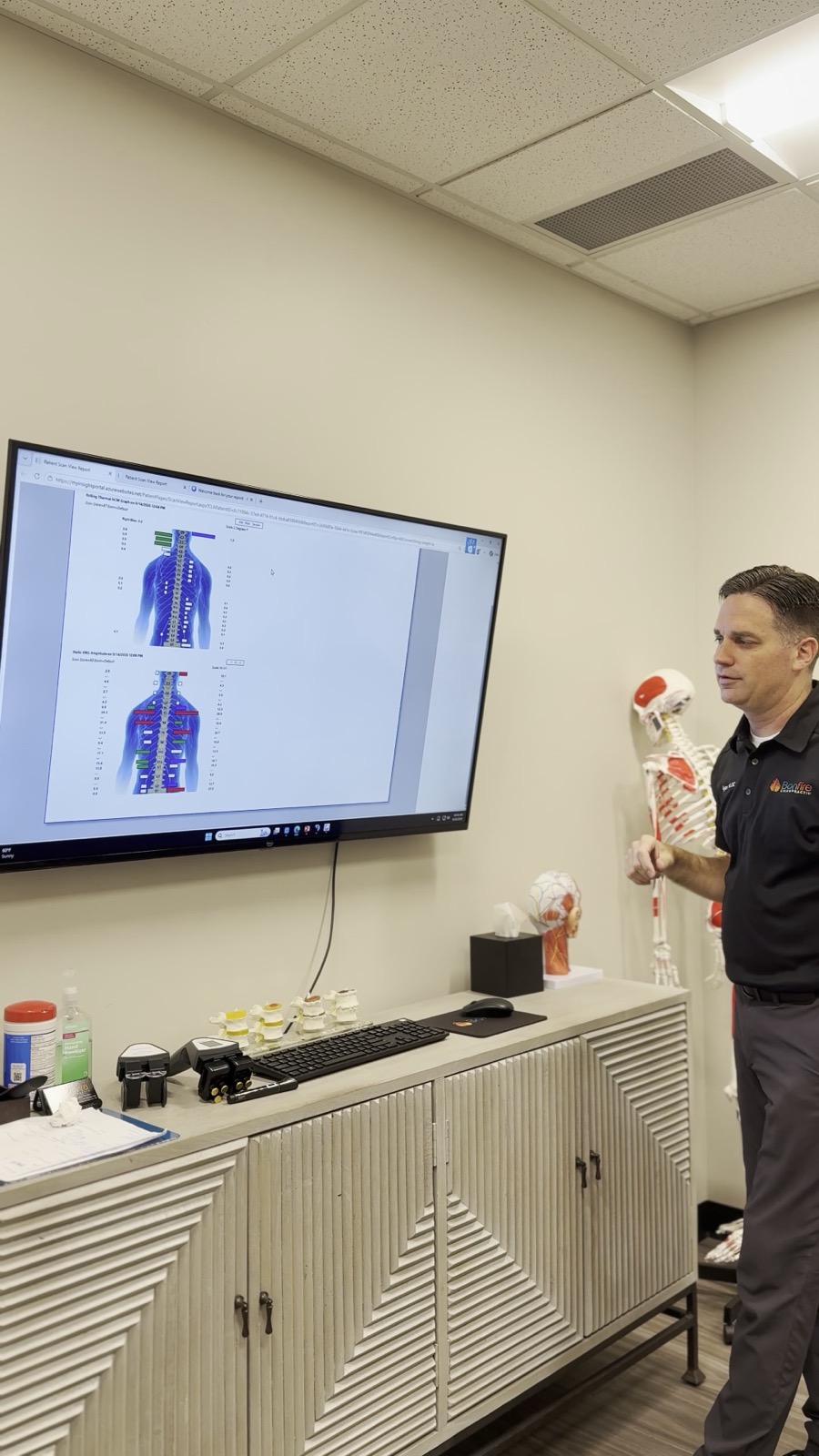
What is neurologically based chiropractic?
About a minute long.
What is neurologically based chiropractic?
Torque Release Technique and neurologically based chiropractic
Our practice utilizes Torque Release Technique (TRT), a gentle, neurologically focused chiropractic technique.
The philosophy behind neurologically based chiropractic is different from simply thinking about the spine as something that needs to be cracked or manipulated whenever it feels tight. We are interested in the relationship between spinal function and the nervous system. Our goal is to provide a specific approach based on what we find during your evaluation rather than simply adjusting whatever area happens to hurt that day.
That distinction matters. If someone has low back pain, for example, the source of the problem isn't necessarily limited to the exact location where the person feels discomfort. The body works as an interconnected system. That's why our evaluation looks at the bigger picture.
What types of concerns do people bring to us?
Because our focus is the nervous system, we work with people who present with a wide variety of concerns.
It's important to understand that we do not claim chiropractic care cures or treats every condition listed below. Many symptoms can have numerous causes, and some require medical evaluation or treatment. Our job is to determine whether chiropractic care is appropriate and whether nervous system and musculoskeletal factors may be relevant.
Some of the concerns people commonly discuss with us are below. If dizziness is your main concern, see our vertigo page as well.
Concerns people commonly discuss with us
Neck and back pain
Neck and back problems are among the most common reasons people seek chiropractic care. Modern lifestyles can place significant physical demands on the spine. Long hours sitting, repetitive movements, previous injuries, athletic activity, and other factors can contribute to changes in movement and discomfort. Our approach looks beyond the location of the pain and considers the overall relationship between spinal function, movement, and the nervous system.
Headaches and migraines
Headaches are complex. There are many different types and many potential contributing factors. Sometimes a headache can have a musculoskeletal component, while others may involve neurological, vascular, hormonal, medication-related, or other factors. A nervous system-focused evaluation can help determine whether chiropractic care may be appropriate. But headaches should never automatically be assumed to be a chiropractic problem. A sudden, severe, unusual, or rapidly changing headache requires appropriate medical evaluation.
Stress and physical tension
Stress doesn't always remain in your thoughts. You may notice it in your shoulders, neck, jaw, breathing, sleep, digestion, or energy levels. When the nervous system is repeatedly exposed to stress, the body has to continually adapt. Chiropractic care isn't a treatment for psychological stress or mental health disorders. But when physical tension and nervous system regulation are part of someone's overall health picture, chiropractic care may be one component of a broader strategy.
Sleep difficulties
Sleep is essential for recovery. Yet many people struggle to fall asleep, stay asleep, or wake feeling restored. There can be many reasons for this. Stress, pain, lifestyle, medications, sleep disorders, environment, and other factors can all influence sleep. If physical tension or musculoskeletal factors are contributing to someone's difficulty sleeping, addressing those factors may be helpful. However, persistent sleep problems should be appropriately evaluated rather than automatically attributed to the nervous system or spine.
Digestive and gut concerns
Your brain and digestive system communicate continuously through what is commonly called the gut-brain axis. Stress can influence digestive function, and many people notice changes in digestion during stressful periods. People sometimes come to us with digestive complaints alongside significant stress or other nervous system-related concerns. We do not claim that chiropractic care cures digestive diseases. Instead, we look at whether nervous system regulation and physical factors may be relevant to the bigger picture. Persistent or severe digestive symptoms should receive appropriate medical evaluation.
Brain fog and concentration
Brain fog is a term people often use to describe difficulty concentrating, mental fatigue, forgetfulness, or feeling less mentally sharp. Brain fog isn't a specific diagnosis. It can have many potential causes, including poor sleep, stress, nutritional issues, medications, illness, hormonal changes, and other factors. Our approach is to consider the whole person rather than assume that one explanation applies to everyone. Sleep, stress, physical activity, nutrition, and neurological health all deserve consideration. Chiropractic care may be appropriate for some people as part of a broader health strategy.
Balance and coordination
Balance requires communication between several systems. Your eyes, inner ear, muscles, joints, brain, and nervous system all contribute to your ability to maintain stability. Because of this, changes in balance or coordination can have many potential causes. A chiropractic evaluation may be appropriate in certain situations, but new or significant balance problems require careful evaluation. If balance problems are accompanied by sudden weakness, numbness, difficulty speaking, vision changes, severe headache, or other neurological symptoms, prompt medical attention is important. Our vertigo page covers dizziness in more detail.
What about children?
Children's nervous systems are constantly developing. They are processing enormous amounts of sensory information as they learn to move, communicate, interact, and adapt to their environment. At Bonfire Chiropractic, we see families who are interested in supporting their child's neurological and physical well-being. Children are not simply small adults. They require age-appropriate evaluation and care. We do not claim that chiropractic care cures ADHD, autism, developmental disorders, or other complex conditions. Those conditions require appropriate medical, developmental, educational, and behavioral support. Our role is to determine whether chiropractic care may be an appropriate complementary component of a child's overall healthcare plan. See chiropractic for kids.
Nervous system regulation is not just about chiropractic
This is an important distinction. If you come to Bonfire Chiropractic, we're not going to tell you that an adjustment is the answer to every problem. Your nervous system needs more than chiropractic care: adequate sleep, movement, physical activity, appropriate nutrition, recovery, meaningful human connection, and opportunities to experience both challenge and restoration. That's why we encourage patients to think beyond the adjustment. Ask yourself:
- Am I sleeping enough?
- Am I moving enough?
- Am I recovering enough?
- Am I spending time outside?
- Am I managing stress effectively?
- Am I maintaining healthy relationships?
- Am I giving my body the resources it needs to adapt?
Chiropractic care can be one piece of the puzzle. It should not be the entire puzzle.
The goal is adaptability, not perfection
Your nervous system will never be completely free of stress. And that's okay. Stress isn't inherently bad. Exercise is stress. Learning is stress. Building muscle is stress. Even positive events can create physiological demands.
The goal isn't to live a completely stress-free life. The goal is to develop the capacity to adapt and recover. A resilient nervous system isn't one that never becomes activated. It's one that can respond appropriately and return toward balance when the demand has passed.
It changes the conversation from “how do I eliminate every source of stress?” to “how can I improve my ability to adapt to the stress that life inevitably brings?”
Why choose Bonfire Chiropractic?
At Bonfire Chiropractic in Meridian, Idaho, our practice is built around a specific philosophy: the nervous system matters. We believe your health deserves more than a symptom-based conversation. That's why we focus on the relationship between the brain, spine, and nervous system.
We use neurological and physiological assessments to gather information. We utilize a gentle, neurologically focused chiropractic technique. We take time to understand your history. And we want you to understand what we're doing and why we're doing it.
Our objective isn't to convince you that chiropractic care is the answer to everything. It's to determine whether we can help. Sometimes the appropriate recommendation will be chiropractic care. Sometimes we'll recommend that you work with another healthcare professional. Sometimes the best answer is a combination of approaches. That's what responsible healthcare looks like.
This page is general education, not medical advice. Individual results vary. Talk with a qualified healthcare provider about your own situation, and never stop a prescribed medication without speaking to the doctor who prescribed it.
Chiropractic care may not be appropriate for every person or condition. If you have new, severe, sudden, or worsening symptoms, particularly neurological symptoms, seek appropriate medical evaluation and care.